Accessibility Statement

Information on the digital accessibility of our website

We are committed to ensuring that our website is accessible in accordance with the applicable legal provisions on digital accessibility.

The legal basis for this is, in particular, the Austrian Federal Act on Equality for People with Disabilities (BGStG) and its implementation in the field of digital accessibility, the Web Accessibility Act (WZG) implementing Directive (EU) 2016/2102 on the accessibility of websites and mobile applications of public sector bodies, as well as the Austrian Accessibility Act (BaFG), which sets out comprehensive requirements for the accessibility of digital products and services – including websites – and, amongst other things, requires compliance with the Web Content Accessibility Guidelines (WCAG).

This website is currently partially compliant with accessibility requirements. Content that is not yet accessible is being identified and rectified on a step-by-step basis.

Some of the PDF documents available on the website are not currently accessible.

Third-party content embedded on our website is outside our area of responsibility and has not been checked by us for accessibility.

The accessibility of this website was assessed as part of a self-assessment based on WCAG 2.2 and is continuously reviewed and improved.

If you notice any issues regarding the accessibility of our website, please contact us:

Markus Morandell
Kalkofenstraße 10d
6425 Haiming

t. +43 650 266 5292
m. office@privatskischule-soelden.at

We will endeavour to deal with your enquiry as quickly as possible and get back to you.
What you need to know – Everything you need to know at a glance
Key facts at a glance

Each programme is tailored to your individual objectives, skills, experience and availability. As a first step, Markus will work with you to determine which format suits you best – simply fill in the contact form.

t. +43 650 266 5292
m: office@markusmorandell.com

Kalkofenstraße 10d
6425 Haiming

Yes – corporate events, group sessions, talks and special formats are available on request.

The pre-season performance sessions take place on the glacier in Sölden (from October). Ski performance coaching and alpine performance & risk management are held in Sölden or on the Arlberg (Lech, Zürs, St. Anton, Stuben), depending on the programme and as agreed.

State-certified mountain and ski guide, state-certified ski and snowboard instructor, former national team athlete and national coach, former head coach of the Swiss national snowboard team, long-standing member of the Austrian national coaching team.

To begin with, we’ll clarify your personal goals, your current level and the areas you’d like to work on. Right from your first runs, I’ll be observing your movement patterns, timing, balance and how you handle the prevailing snow and terrain conditions.

Based on this, we’ll develop targeted adjustments that will make the biggest difference for you. Depending on the situation, we’ll work on specific movement exercises, different turning radii and speeds, varied terrain or short technical sequences.

The key here isn’t perfect movement according to a set formula, but a functional technique that can adapt to different situations.

As the session progresses, we increasingly apply what we’ve worked on to free skiing. In this way, individual technical cues become movements that feel natural and can be reliably recalled even under changing conditions.

No two coaching sessions are therefore exactly the same – your goals, your skiing ability, the terrain and the current conditions determine the focus.

After the summer break, the initial focus is on rediscovering your own sense of movement and building a solid foundation for the coming season.

To begin with, we’ll get an overview of your current level. This is less about a formal assessment of technique and more about asking: Which movements are already working well? Where are there issues with timing, balance or confidence? And which habits might have crept in?

We’ll then work specifically on the most important fundamentals. Depending on your skiing ability, these may include balance, mobility, pressure build-up, turn control, rhythm or adapting to different speeds and turn radii.

The focus is on quality rather than quantity. Short, targeted exercises alternate with free skiing, so that new movement patterns can be integrated back into a natural sequence of movements as quickly as possible.

By the end of the session, you shouldn’t simply have ‘been skiing again’, but should have a clear sense of where you stand and what you should be focusing on during the first few weeks of the season.

A day like this doesn’t begin with the first descent, but rather with our joint planning.

We assess the current conditions, weather, snow cover, avalanche risk and possible terrain options, and discuss together what decisions this will inform for the day.

Whilst out on the mountain, this plan is constantly reviewed. The terrain, snow, visibility, the group and current observations can provide new information and alter the original assessment.

It is not just about which decision is made, but above all about how it is reached: Which pieces of information are relevant? Which ones can be misleading? What alternatives are there? Where do unnecessary risks arise? And when does it make sense to adjust the original plan?

Depending on the focus, we combine these decision-making processes with topics such as skiing technique, terrain selection, line choice, group organisation, communication and tactical behaviour.

The result is not a theoretical course in the traditional sense, but a practical day out in the terrain, where perception, decision-making, movement and risk management are directly interlinked.

The aim is not simply to adopt decisions, but to increasingly be able to understand the underlying thought and decision-making processes for oneself.

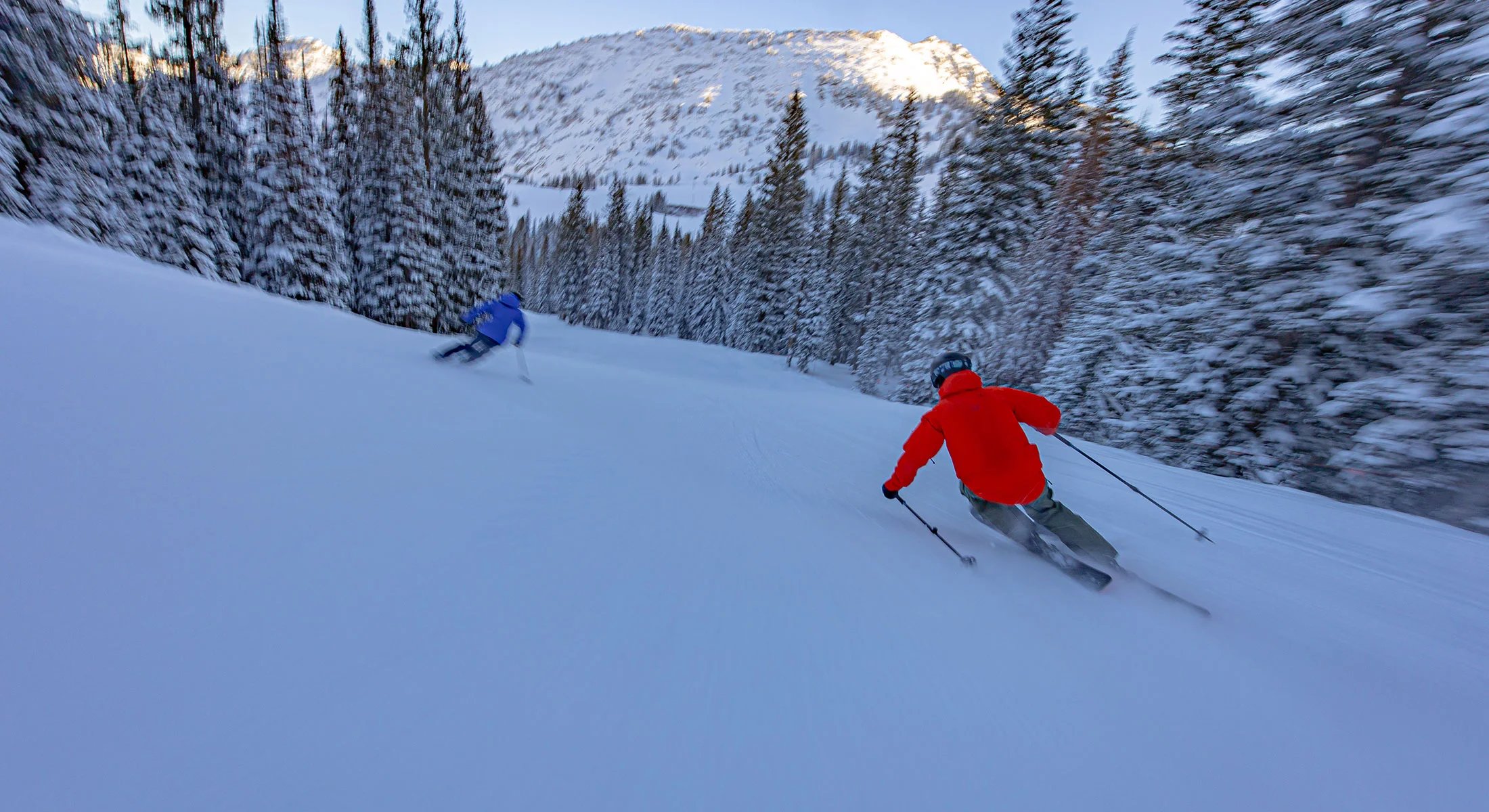
Skier in a red jacket making a dynamic turn on a freshly groomed slope
Personal coaching
begins with a
clear discussion.